Chou Family 周家族

Life of Chou Fu-chuan
Pauline interviewed her father in Hong Kong on 1977, when Fu-chuan was 95, and recorded his memories of his life. Below are her notes and their translation.
In 1974, at the age of 92, Fu-chuan wrote his own Testimony. Click: TESTIMONY

Born 1882 May 4th.
Parents were poor farmers. Family owned 8 mou of land (1 1/3 acre) for growing vegetables. In the 16th year reign of Emperor Guangxi (1890) a great flood forced the family to sell half the land. Hearing rice was given out, Fu-chuan at age 8 walked 25 li (7.76 miles) with his mother to Peng Ge Zhuang, but when they got there they discovered the rumor was false. Only when getting food from his mother’s elder sister did they survive.
At age 12, a Protestant couple named Guo rented a room in Fu-chuan’s family house.

This couple led Fu-chuan’s family to the Lord. The couple became Fu-chuan’s godparents.
In 1892 this couple arranged for Fu-chuan to enter Fu Yin Tang, the Primary School in Fu-chuan’s village Huang Cun. At school Fu-chuan learned to recite by memory the Gospel according to Mark.
In 1894, due to his exceptional abilities, Fu-chuan was transferred to study in Peking. Fu-chaun’s father took Fu-chuan to the home of Liu Ming-chuan outside of Peking’s Shun Ji Gate. Liu, who obtained his degree in America, was the headmaster of Fu-chuan’s school. Liu gave Fu-chuan new clothes and daily use items. Hiring a donkey cart, they rode to Peking entering through the Chung Wen Gate.

福音堂 Fu Yin Tang, - name of school at entrance

Chung Wen Gate, one of nine gates into Inner Peking (Tartar) City.

In Peking Rev. Liu Hai-lan, or known in English as Rev. Hiram Harrison Lowry, an American missionary, accepted Fu-chuan into Hui Wen Primary School.
Fu-chuan became the top student. When Rev. Lowry played tennis with his son, Fu-chuan picked up balls for them and earned a silver dollar a month. Fu-chuan used his money to buy a Da Qua (Chinese long gown) of thick durable material. He bought this from the store of Mr. Zhang, a fellow convert. This was his first purchase in his life.
The school provided food and lodging. In the bedroom warm air came out of tubes. There were blue sheets on the mattress. There was free tea leaves for drinking. Elderly ladies would mend clothes for the students. There was a separate bathroom for hygienic cleaning where students had a wash once a week.

Rev. Hiram Harrison Lowry

Fu-chuan skipped over the miserable chapter of his life in 1900 - during the Siege of Peking. Boxers and Imperial Qing Army troops surrounded and bombed the Foreign Legations Quarters in Peking, where all foreigners, missionaries, and many Chinese Christians including Fu-chuan were trapped.

Foreign Legation Quarter during Siege
At that time, foreigners were only permitted
to live in a small section of Peking

Boxers - Chinese dissatisfied with foreigners, in particular
missionaries, taking their properties for Churches,
and blamed railroads built by foreigners for
taking away their livelihoods, and along the railroads
the telegraph lines ruining their ancestral graves' feng shui.

Inside the Foreign Legation Quarters - on left in near distance is the British Legation,
in the middle is the Imperial Canal, where waste water flowed out of the Forbidden City,
on right is Prince Su's walled-in estate Su Wang Fu, where Chinese Christians were sheltered.
The Siege lasted from June 20 till August 14, when eight foreign nations' troops (British, French, German, Italian, Russian, Austrian-Hungarian, American, and Japanese) marched from Tientsin to Peking and defeated the Chinese.

Su Wang Fu at the end of the Siege.
In Harvard University's library there is a personal account of the Siege recorded by a Chinese who was a professor at the Methodist missionaries' school. Thanks to Eugene Chow (63) a professional was paid to translate the 106 pages of formal Classical Chinese into English. According to custom at the time, it is read from right to left, from top to bottom.
On page 59 second to last line Chou Fu-chuan is mentioned.


At that time the Qing government required all Chinese to wear a queue, so students helped each other to shave and braid their hair.
Progressing up to Middle and High school, Fu-chuan eventually graduated from College in 1907 at age 25. In his third year of college, he conducted his own English class at the school. In the summer, he was hired to tutor fellow students. One summer he tutored at the Ma family, where room and board was provided. He earned enough for the next year’s school fees. A few years prior the school would provided travel money to return home for the holidays, but this was stopped due to the increased enrollment.

People understood the advantage of an education, so rather than fearing foreign missionaries, they flocked to their schools and hospitals. That demand allowed schools and hospitals to collect fees.
In December of 1907, Fu-chuan graduated with classmate and fellow dorm-mate Liu Jie-ping. Missionaries Effie G. Young and Alice Turrell introduced them to two young women. At Ashbury Church they had a double wedding, Fu-chuan marrying Jie-ping’s sister Liu Rui-hong, Liu Jie-ping marrying Wen Rui-gui.

Day after the wedding both newly-wed couples travelled to Feng Run County East of Peking to visit Liu Xiang-kui, father of Jie-ping and Rui-hong. After two weeks, they returned to Peking, where they learned of the passing of Headmaster Qin Long-zhang. Rev. Lowry appointed Fu-chuan Vice-Chancellor and head master of the High School. Fu-chuan remained in this position for 12 years.
In 1913 Fu-chuan qualified as assisted pastor.
In 1915 he was elevated to senior pastor, and earned his Master Degree. He was appointed as deputy Professor in English at the University.
In 1917 the Director of Y.M.C.A. Mr. Sherwood Eddy came to Peking to give a series of lectures. Fu-chuan was asked to be the translator. A special pavilion was built to accommodate four thousand people for one of the events.

Besides speaking at the largest theater in Peking, Fu-chuan also translated for Eddy in other districts of Peking such as Tong Zhou, and Bao Ding in Hebei province southwest of Peking. Eddy asked Fu-chuan to accompany him to central China as translator, but this request was denied by the school’s Chancellor.
A Teachers’ College in Henan Province offered Fu-chuan the position of headmaster, at five times his salary ($40 dollars). This was also rejected by Fu-chuan’s Chancellor.
In 1918 Fu-chuan spent his own money to further his studies in America. He borrowed US$1,000 from schoolmate Liu Dong-hai at 1 percent interest. At Syracuse University’s Teachers College in New York State, Fu-chuan earned his PhD degree in three years.

Based on Rev. Lowry’s reference letter, Fu-chuan was given a paying position teaching Chinese History. He also was granted two years of scholarship by Qing Hua University (part of the Boxers indemnity). During summer vacations, Fu-chuan gave testimonies at churches in Vermont, New York, Tennessee, Indiana, Wisconsin. He earned enough speaking fees to fully repay his US$1,000 loan.
In 1921 Fu-chuan returned to China. On his way he made a stop in Yellowstone National Park, where he had a strange experience. Sitting a few rows behind him on the tour bus was an American couple. The husband told his wife the Chinese sitting in front is a pastor.

1918-19 Record showing address of Chou Fu-chuan

1919-1920 Record showing Fu-chuan moved into Sims Hall

1920-1921 Record showing Fu-chuan at Sims Hall

1921 Commencement Program listing Fu-chuan's degree

She asked how do you know? He said, if you don’t believe me, ask him. When the bus stopped at the top of the mountain for passengers to experience snow (this was in July), this couple asked Fu-chuan if he was a pastor. When he confirmed he was, the husband told his wife, see, I was right.
Upon Fu-chuan’s return he was appointed Deputy Administrator of Education for the Methodist Church, based in Shanghai. His duties required him to travel throughout the region to inspect the schools. Once heading to Shandong, his former schoolmate, principle Wang Shou-tong had entrusted one of his parishioners who worked at the Jing Pu Railroad to look after Fu-chuan.

On the 2nd class train carriage a man ran directly up to Fu-chuan and asked if he was Rev. Chou. Having never met before, this was also a strange event.
In 1923 Fu-chuan went to Tianjin as teacher at Huiwen High School and also as school inspector.
A few years later, Fu-chuan transferred to Nan Yuan, 3 miles from Huang Cun where he was born, to act as Dean of Studies at a school run by followers of General Feng Yu-xiang. The school was in a park that used to be the Emperor’s hunting grounds. His dormitory was the Emperor’s bed chamber.
Fu-chuan remembered once Fu-chuan’s father went to this park in search of kindling. Fu-chuan’s mother told Fu-chuan to go along to help carry what they could gather. As night fell, they lost their way. They encountered ghost fires - (flickering blue lights from decaying fluorescent matter known as will-o’-wisps).


Due to battles between warlords, Fu-chuan’s school relocated to Sui Yuan, north of the Great Wall, now Inner Mongolia. A year later, Fu-chuan moved back to Peking to be in charge of Education at Huiwen College.
In 1927, a dispute arose between him and the school Chancellor Gao Feng-shan. Fu-chuan believed students should ask permission if they wish to leave the school premises. Chancellor Gao insisted students can come and go as they wish. Fu-chuan resigned.
Recommended by the Director of Peking’s YMCA Chen Li-ting, Fu-chuan was employed as Professor of English Language at Hebei University.
At that time, Fu-chuan was involved with Ji Hua Hui (Saving China Association). Made up of missionaries, educators, doctors, their mission was devoting their lives to spreading the gospel. As a professor returning from America, Fu-chuan qualified for a monthly salary of $200 from the Church. To conserve money to support the growing missionary community, Fu-chuan offered to reduce his salary by half.
1921 Commencement Program listing Fu-chuan's degree
1921 Commencement Program listing Fu-chuan's degree

A year later, Fu-chuan was promoted to head the English Department, with a salary of $300 per month. He resigned from the Church.
That summer Ruth’s husband Qin Zhen-xing sent an urgent letter to Fu-chuan. (Ruth had married Qin that year, and they lived in Shenyang where Qin worked as Secretary at the American Embassy to the Japanese puppet regime Manchuguo.) Qin said the Commercial Department of Shenyang’s American Embassy urgently needed someone to handle foreign relations and translations. If Fu-chuan was interested, he should contact Mr. A.B. Calder at Peking’s American Embassy. Upon meeting Fu-chuan, Calder wrote down in his notes “speaks excellent English”. Calder asked what salary Fu-chuan wanted. When Fu-chuan replied “US$200”, Calder told Fu-chuan he will report to Shenyang.

Go Yan To go 溝沿頭 where Fu-chuan bougt a house after he moved out of the Methodist compound
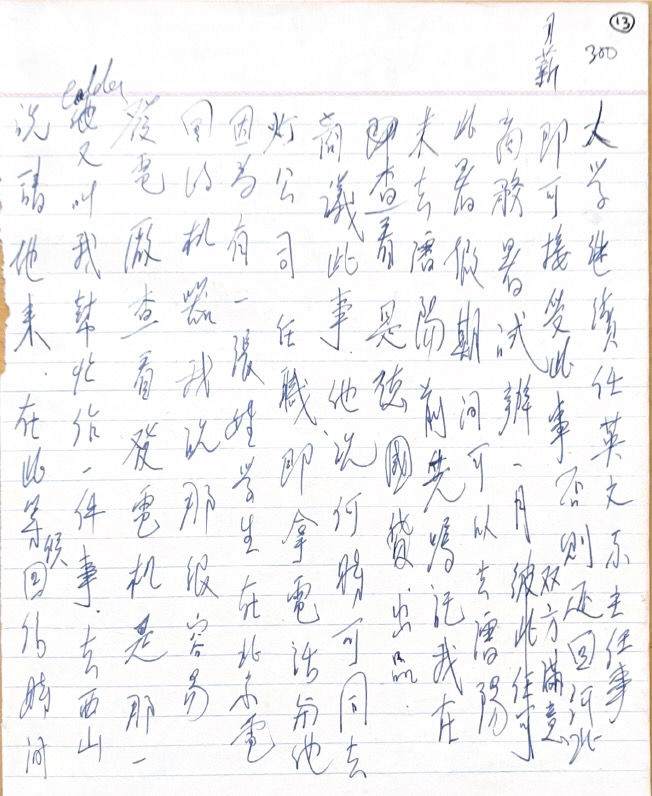
Shortly after, Calder asked Fu-chuan to visit West Mountain Power Station to find out which country manufactured the generator. Fu-chuan told Calder that was easy, as Fu-chuan’s student surnamed Zhang worked at the Peking Electric Company. With a telephone call, Fu-chuan arranged the visit, and ascertained the generator was manufactured in Germany. Within days, Fu-chuan received the invitation to go to Shenyang. His salary would be US$300.
Since summer vacation was approaching, Fu-chuan negotiated a trial period of one month in Shenyang. If it did not work out, Fu-chuan would continue his present position at Hebei University

Arriving in Shenyang, both parties were satisfied, so Fu-chuan resigned from Hebei University.
The Director of the Commercial Department Mr. Erhard organized a “Tuesday Tiffin Club”, inviting as members Ambassadors of different embassies in Shenyang and local merchants. Each week a guest speaker would be invited. The Club’s President was Wang Zheng-fu, brother of Wang Zheng-ting, who had been China’s Foreign Minister, Minister of Finance, Minister of Justice and acting Premier. Fu-chuan was the Club’s Secretary and Treasurer.
The General Manager of the Bank of China in Shenyang Mr. Gu Zi-yu asked Fu-chuan for English lessons. A chauffeured car would pick up Fu-chuan each morning before office hours, bring him to Mr. Gu’s bank for an hour’s lesson, then send Fu-chuan to the American Embassy. Mr. Gu paid Fu-chuan $200 each month.

1930's Shenyang in Manchuria. The city was previously known as Mukden.

At this time Fu-chuan earned US$700 a month, the most in his life. At that time, the majority of Chinese earned 10 to 15 Chinese yuans a month. His income converted to 1,750 Chinese yuans. To send Louise and Hazel to study in America with three years’ worth of clothes, Fu-chuan said it was “easy as flipping over one’s hand”.
In September of 1931 Japan invaded Manchuria, starting the aggressive expansion into China. In Shenyang Chinese working for the Americans came under suspicion. Their movements were tracked by plainclothes agents. Early one morning someone came to Fu-chuan’s home.

1931 September - Japan invades Manchuria

It was a newspaper seller asked if Mr. Chou read a certain newspaper that was banned by the Japanese. He was told no immediately. After breakfast, the car came to pick up Fu-chuan for the English lesson at the Bank of China. The newspaper seller was still waiting by the door and asked Fu-chuan the same question. Fu-chuan told him no, and got into the car. Fu-chuan asked the chauffeur if he spoke with the man. The driver said no, but the man was leaving when the car arrived, so the man decided to wait.
At the Bank of China Fu-chuan relayed this incident to Mr. Gu the General Manager. Mr. Gu said he himself was often followed by plainclothes agents.

Chinese taken prisoners by the Japanese


In addition, Japanese army officials frequently asked his bank to refuse payments to certain individuals, creating difficulties for the bank. Mr. Gu said some of his clients have disappeared.
When Fu-chuan reached the American Embassy that morning, he resigned his position. The next day he received from the manager of the railroad department two first class tickets to return to Peking. To pass from Japanese occupied territory to China at Jin Zhou, first class passengers are exempt from Japanese inspection, where as 2nd and 3rd class passengers are scrutinized. Fu-chuan and Rui-hong were invited by Fu-chuan’s fellow schoolmate who was the station master to spend the night at his home. The next day,

with arrangements made by the Peking station master, another schoolmate, they safely arrived with their luggage back to their Peking home.
In Peking, arranged by Father O’Tool, Fu-chuan met the Principal of Furen University’s Chen Yuan, and Secretary-General Ying Qian-li, whereupon Fu-chuan was offered the position of English Professor, In addition, he obtained the post of English Phonetics at Teachers College, and taught English at the YMCA night school. Later he was invited by Vice Chancellor of China University Wang Zheng-ting to Head their English Faculty.

Book of English Phonetics by Fu-chuan
published in 1934 by the Huiwen School

Inside the book, Fu-chuan's address is listed as
Inner City, Go Yan To #39
Telephone number 4567
From the telephone number it is clear Fu-chuan had
great influence and respect.

1837 July - Peking fell to the Japanese
Fu-chuan skipped over the Japanese occupation of Peking. For an in-depth discussion of what migt have happened, read the dramatized Life of Chou Fu-chuan stored on the Google Drive that includes memories by many of his children - click LIFE OF CHOU FU-CHUAN

Mao's Communists liberated China, establishing
The People's Republic of Chin on Oct 1, 1949

Early in 1950, after the People’s Republic of China was established by the communists in October of the previous year, English faculties of Peking’s universities were instructed to
report to Beiman Girls High School. There, they were told they would be assigned to Harbin, where a special school will be established to train educators to teach English throughout China.
When their train got to Shenyang, barely halfway to Harbin, it was announced plans have changed. They would be going to Dongbei University in Changchun for “studies” (brainwashing in communist parlance). As Fu-chuan was the oldest in the group, he stood up and said a Chinese phrase that meant “to issue a morning order and rescind it by evening, failing to keep one’s word”. A man in charge said with a Sichuan accent “The Communist Party will often change plans. Anyone who oppose or go off track risk having their head chopped off”.
In Peking before they left, Fu-chuan was promised the same salary as he was earning before. Instead, after they arrived, his pay was 300 jin (330 lbs) of millet.

They were subjected daily to long speeches during the day, and evening group discussions. After five months, everyone was told to write a confession. One of the topics was “What was your lifetime thought?” Fu-chuan quoted passages from the Bible:
Timothy 4.12 Let no one despise your youth, but set an example to the believers in word, in conduct, in love, in spirit, in faith, in purity.
Mark 10.45 For even the Son of man came not to be ministered unto, but to minister, and to give his life a ransom for many.
Matthew 7.12 Therefore, whatever you want men to do to you, do also to them, for this is the law and the Prophets.
Matthew 22.35/40 Then one of them, a lawyer, asked Him a question, testing Him: “Teacher, which is the great commandment in the Law”. Jesus said to him, “You shall love the LORD your God with all your heart, with all your soul, and with all your mined. This is the first and great commandment. The second is “You shall love your neighbor as yourself.” Upon these two commandments hang all the Law and the Prophets.”

John 13.34/35 “A new commandment I give to you, that you love one another, as I have loved you, that you also love one another. By this all will know that you are My disciples, if you have love for one another.”
Fu-chuan thought for sure his “confession” would create problems, but no one came to question him.
(P24)
Fu-chuan’s conclusion about Communism -
1. No god
2. No religion
3. Anti-Confucius
4. All about hate not love
5. Claims man came from monkeys
Upon his return to Peking, Fu-chuan no longer wished to work for the Communist Party. Two of his students came to Fu-chuan to ask him to join them at Zhangjiakou Industrial College to teach English. In fact, it was a university, but did not use the name to avoid detection. After Fu-chuan refused the first time, the two came back with a Party official. Fu-chuan knew he had to accept.


The very next day Fu-chuan left for his new assignment. His accommodations were excellent, his pay was 900 jin of millet.
At that time there was a 10,000 word phonetic dictionary published in China. Fu-chuan preferred the Wade-Giles romanization system, and the Wade-Giles Dictionary was easily available. He taught using both systems. Also teaching phonetics was another professor who wanted to please the Party Cadre at the school, so did not using the Wade-Giles Dictionary because it was published in America. Two weeks after classes started, the school administrator advised Fu-chuan

students found his teaching method much easier to learn. They liked Fu-chuan’s dedication. He will be teaching both classes. The other professor was reassigned to teach another subject.
One day Pauline and her husband Hilton showed up in Zhangjiakou. Pauline tried to convince Fu-chuan to retire and join them in Hong Kong, but Fu-chuan was obligated to finish his one-year teaching contract.

Before summer ended, another teaching contract came to Fu-chuan. Hurriedly Fu-chuan arranged to have a photo taken for memory’s sake, resigned to the proper authority due to his retirement and to join his children in Hong Kong.
In Hong Kong, Fu-chuan and Rui-hong lived with Harold, their only son. Harold was teaching Mandarin at Hong Kong University’s Asian Language School. Often Fu-chuan would have dinner with Harold’s students, conversing in Mandarin for their practice. After one such evening, an invitation came for Fu-chuan to teach Mandarin at Harold’s school. For the next eight years, Fu-chuan taught there.

On 1955 April 11 Easter Monday Rui-hong passed away. They were married 48 years.
In 1960 encouraged by Louise, Fu-chuan retired from teaching. That year he married He Ming-ren (Alice Dungey), moved to Taipei and lived there for the next 10 years.
In 1970, Louise mailed to her father two plane tickets, so that October Fu-chuan and his 2nd wife moved back to Hong Kong. Louise paid for Fu-chuan’s living expenses.
1971, Louise invited them to go with her on a world tour, including America, Italy, England.
PAULINE'S NOTES -
On December 20, 1973 Fu-chuan had a stroke that paralyzed the right side of his body. He stayed at St. Theresa’s Hospital in Kowloon until February 12 1974.
After three months, Fu-chuan regained strength of his right side, and was able to get up from his bed by himself.
On May 4, 1974 Louise had a birthday party for Fu-chuan, with 20 guests. Fu-chuan could walk by himself without a cane.
In 1976 Fu-chuan fell at home, but did not sustain any injury.
In 1976 between July 23 and August 16 Hazel came to visit her father. Louise, Hazel, Eliza, Pauline, played music together.


The next year, 1977 July-August, Hazel came again to visit for two months, and Josephine came for one month. They stayed with Louise. Eliza spent three days with them. The last day Eliza and Hazel stayed with Pauline. Hazel is overly courteous. It was hard to bear. She lost her temper, driving Eliza to tears. The sisters went to a small restaurant, then toured Shatin and Taipo (Pauline was testing a new driver).